
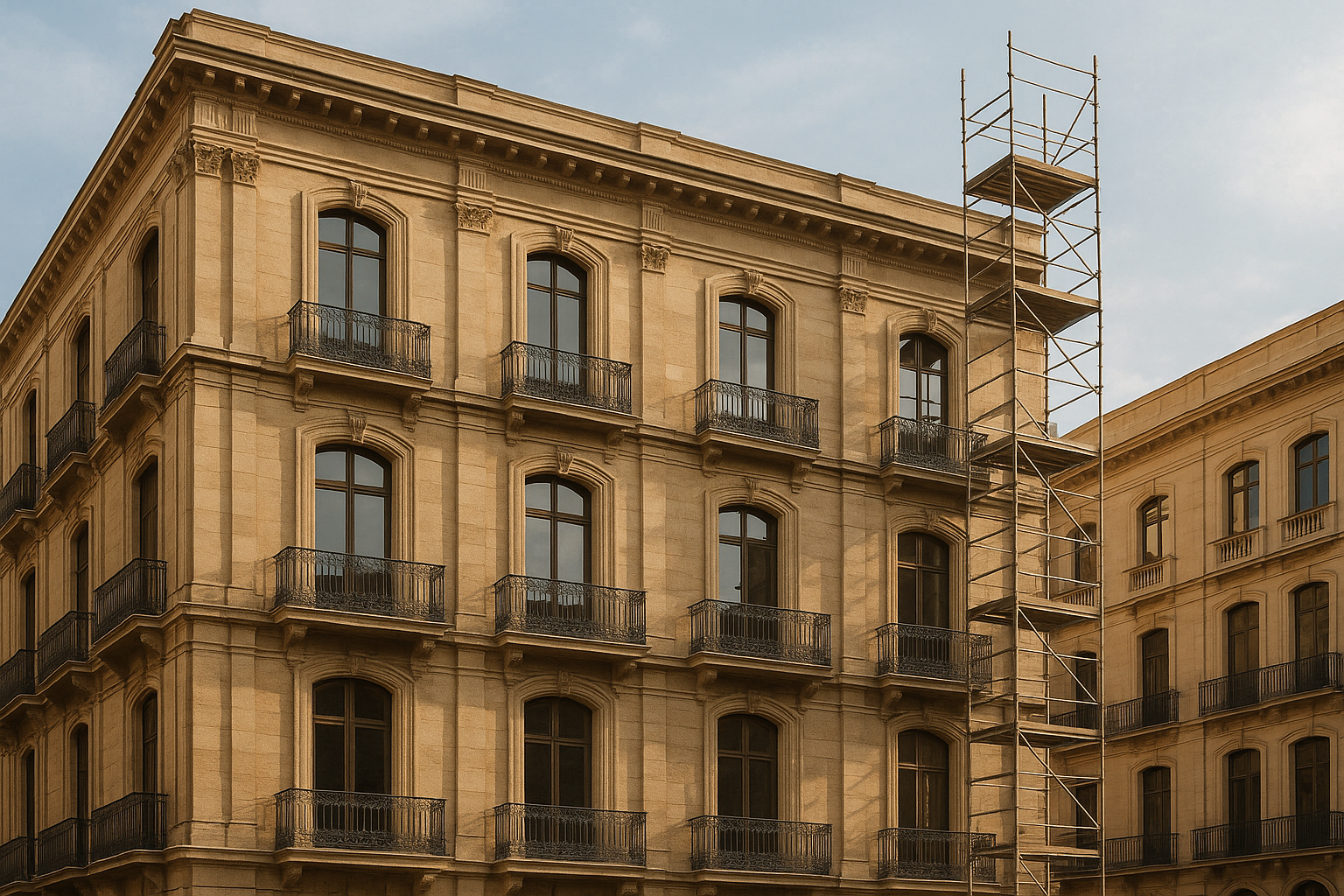
Purchasing an entire historic building—whether for full rehabilitation, residential conversion, rental investment, or long-term patrimonial preservation—requires a much deeper evaluation than buying a single apartment. The operation demands structural responsibility, financial solvency, and a clear strategic vision.
At Doméstica Sede, we work with institutional buyers, private investors, and families seeking to acquire full historical properties, and we know that success depends on a precise and realistic due diligence process.
Below is an essential guide to rigorously assessing the technical, regulatory, and economic condition of a historic building before acquiring it.
1. Structural Diagnosis: the foundation of every decision
In a full building, the structure is the factor most likely to alter the investment budget. It is essential to analyse:
- Condition of load-bearing walls, pillars, and arches
- Timber, iron, or mixed floor slabs
- Deflections, deformations, and additional loads
- Pathologies accumulated through age or previous interventions
A professional structural report can completely redefine the reasonable purchase price.
2. Damp and Roof Issues: the silent and most costly risk
In historic buildings, water-related pathologies tend to be widespread:
- Tiled roofs with infiltration points
- Deteriorated downpipes with long-standing leaks
- Rising damp in ground floors and basements
- Condensation in poorly ventilated courtyards
Before buying, it is crucial to calculate the true cost of full waterproofing or even partial roof reconstruction.
3. Previous refurbishments: quality, legality, and coherence
Many buildings have undergone interventions in past decades that now present problems:
- Improvised structural reinforcements
- Random or chaotic partition layouts
- Concealed installations without documentation
- Alterations affecting protected architectural elements
Understanding the building’s construction history is essential to avoid unwanted structural legacies.
4. General installations: the major hidden challenge
Acquiring an entire building means taking responsibility for:
- Old water and drainage risers
- Obsolete communal electrical networks
- Staircases without fire-protection measures
- Lack of detection and evacuation systems
- Absent or inadequate climate-control solutions
Updating all installations to current regulations can represent a significant share of the total investment.
5. Heritage protection and regulation: the factor that shapes the whole project
Before purchasing, it is essential to understand what is allowed and what is not:
- Level of protection (national, municipal, Grade 1, Grade 2, etc.)
- Mandatory preservation of catalogued elements
- Restrictions on façades, roofs, structural walls, and staircases
- Requirements for major-works permits and technical projects
- Limitations on horizontal division or change of use
A highly protected building is not a problem—but it does require a clear strategy and a specialised team.
6. Consolidation costs and return on investment
For a buyer of full buildings, the key question is:
How much will consolidation, rehabilitation, and value-enhancement truly cost?
This includes:
- Structural consolidation
- Restoration of singular elements
- Complete new installations
- Acoustic and thermal insulation required by law
- Installation or refurbishment of lifts
- Accessibility improvements
- Façade and roof restoration
Accurate calculations prevent budget deviations and increase final profitability.
7. No existing owners’ association: advantages, risks, and opportunities
Purchasing a complete building eliminates the typical issues of a disorganised community, but also requires the buyer to assume:
- All structural maintenance
- All investment decisions
- Full responsibility for works, permits, and safety
In return, it offers project freedom, faster appreciation, and total control over the asset.
8. Transformation potential: the factor that defines success
Beyond the technical aspects, it is vital to understand:
- Real possibilities for redistribution
- Ceiling heights and recoverable aesthetic value
- Quality of patios, terraces, and natural light
- Viability of creating premium apartments, boutique offices, or tourist accommodation (where permitted)
- Historical identity capable of positioning the asset in a higher market segment
A carefully rehabilitated historic building can occupy a category of the market that is difficult to replicate.
Conclusion: buying a historic building requires vision and method
Acquiring a full heritage property is an extraordinary opportunity—but only if evaluated with a professional, technical, and strategic mindset. At Doméstica Sede, we help our clients to:
- Identify real risks
- Reveal hidden potential
- Estimate costs with precision
- Design a rehabilitation plan that is profitable and respectful
If you are considering the purchase of a historic building, we can accompany you from the initial inspection to the definition of the value-enhancement project.